
Air conditioning you cannot hear — or see.
Selection, installation and servicing of air conditioning in apartments, houses, offices and commercial units. We start by calculating the cooling load, not by opening a product catalogue.
The most common mistake with air conditioning is equipment sized by eye. Too little capacity means the unit runs flat out and still fails on a hot day. Too much means the compressor cycles on and off constantly — draughts, noise and faster wear. That is why every quote we issue is preceded by a heat-gain calculation for the actual rooms.
What we take into account when sizing
- Floor area and volume — ceiling height changes the result more than most people assume.
- Glazing and its orientation — a large south- or west-facing window can double the cooling demand.
- Insulation standard and year of construction — a building from 2020 and a tenement from 1930 are two different jobs.
- Number of people and appliances — a server room, a kitchen open to the living room or an office with twenty monitors all add kilowatts.
- Possible pipe route — where the refrigerant lines and condensate drain can run, and where the outdoor unit will sit.
- Stage of the project — before plastering we can conceal the whole installation; in a finished interior we choose the least invasive option.
Types of system we install
The type of unit determines the look, the cost and how much building work is needed. The real differences, without the marketing.
Type 01
Split — a single indoor unit
The classic solution for one room: a bedroom, living room, study or small commercial unit. The best effect-to-cost ratio.
- Capacity range
- 2.0–7.0 kW
- Installation
- 1 day
- Disruption
- low
Type 02
Multi-split — several rooms
One outdoor unit serves 2–5 indoor units. One façade penetration instead of several condensers — which matters in apartment buildings and terraced housing.
- Indoor units
- 2–5
- Installation
- 2–3 days
- Disruption
- medium
Type 03
Ducted — concealed in the ceiling
The unit hides in a plasterboard bulkhead; only the supply grilles are visible in the room. The quietest and cleanest option, but it has to be planned during construction.
- Requires
- suspended ceiling
- Installation
- 3–5 days
- Disruption
- high
Type 04
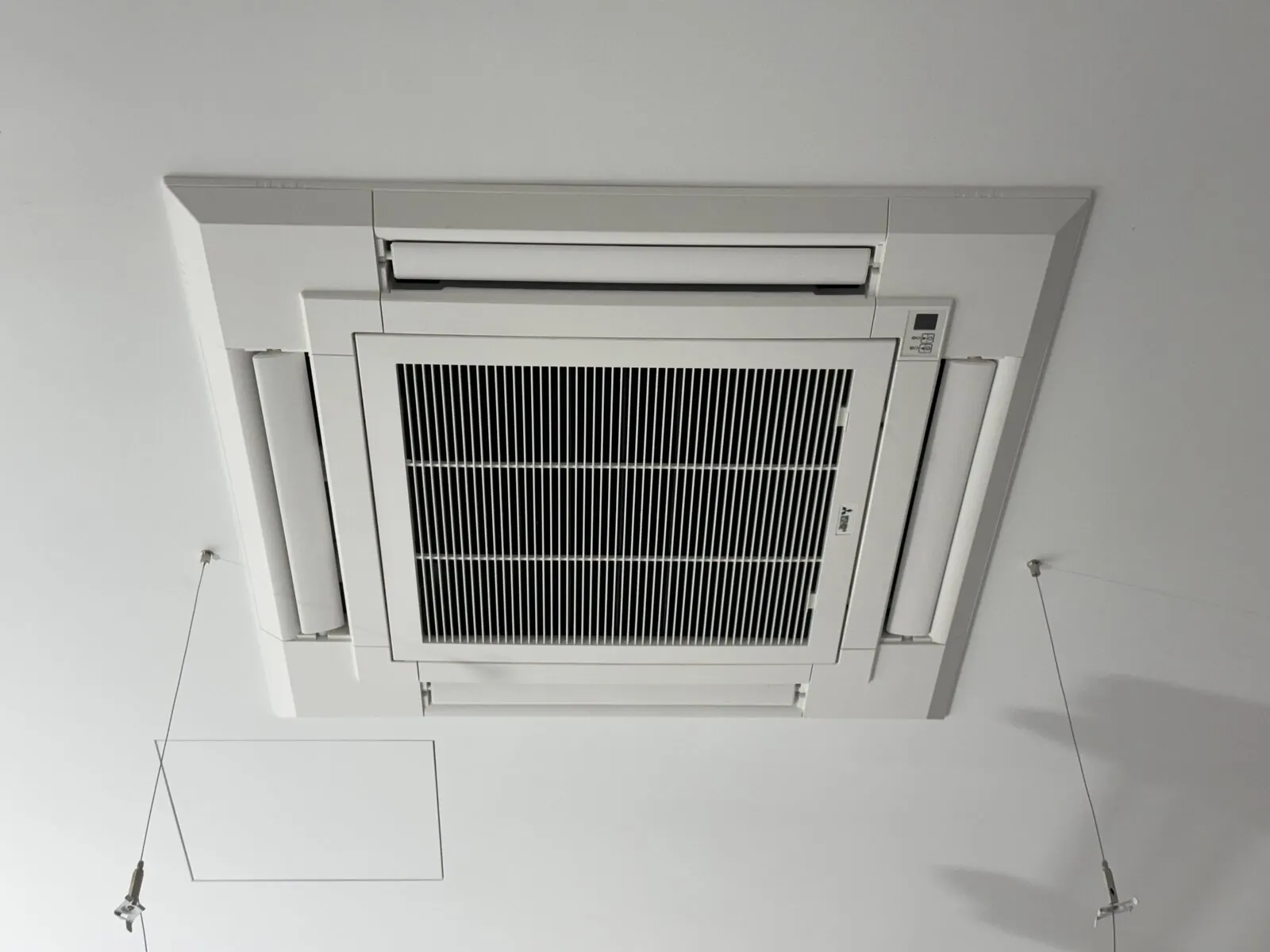
Cassette and floor-standing
A four-way cassette for offices, meeting rooms and retail units; a floor-standing unit where there is no room above the window or in the ceiling.
- Use
- offices, retail
- Installation
- 2–4 days
- Disruption
- medium
Cooling is only half the benefit
Every modern inverter unit also works as an air-to-air heat pump. In March, April or October, when firing up the whole boiler room makes no economic sense, an air conditioner warms a room more cheaply than an electric heater. For many clients that argument outweighs the cooling itself.
Servicing and inspections
An air conditioner draws air from the room and gives it back. A neglected filter and a dirty evaporator mean not only lower performance and a higher bill, but also odour and microbial growth inside the heat exchanger.
- An inspection once a year — before the season: cleaning the filters and heat exchanger, checking pressures, tightness and the condensate drain.
- Evaporator disinfection — when the unit smells unpleasant after start-up.
- Refrigerant top-up — a drop in performance is usually caused by a leak, which has to be found and fixed first.
- Warranty and post-warranty service — we also look after systems installed by other companies.
Systems containing fluorinated greenhouse gases are subject to F-gas obligations, including record keeping and periodic leak checks above a defined charge size. On handover we tell you exactly which obligations apply to your equipment.
Certificate of the Office of Technical Inspection (UDT)
F-gas company certificate
FGAZ-P/09/0805/22
Issued to Royal Instal System sp. z o.o. by the Office of Technical Inspection (Urząd Dozoru Technicznego), Katowice branch, on 21 July 2022, under Article 30(7) of the Polish Act of 15 May 2015 on ozone-depleting substances and certain fluorinated greenhouse gases.
Scope: installation, repair, maintenance or servicing and decommissioning of refrigeration and air-conditioning equipment and heat pumps.
In practice this means we may lawfully handle the full life cycle of a system containing F-gas refrigerant — installation, inspections and repairs, dismantling and refrigerant recovery. It is worth verifying this with any contractor you consider: installing air conditioning without that certificate breaches the regulations, and you are left with equipment that has no valid documentation.
What the installation looks like
| Stage | What happens | Time |
|---|---|---|
| Conversation | We agree which rooms, your expectations and the stage of the project. A phone call and photos are often enough. | same day |
| Site visit | Measurements, choice of pipe route and of the outdoor unit position. | within days |
| Offer | Equipment selection with calculated capacity, a basic and a higher variant, price including installation. | within 48 h |
| Installation | Pipework, units, pressure test, vacuum, charging and commissioning. | 1–3 days |
| Handover | Training on operation and controls, warranty documents, date of the first inspection. | on completion |
Frequently asked questions
How much does air conditioning for one room cost?
The price depends on the capacity of the unit, the length of the refrigerant run and how the outdoor unit is mounted — those three factors can double the figure for the same room size. That is why we give a firm price after a short conversation or a site visit rather than a catalogue range.
Do I need a permit for air conditioning?
In a detached house, usually not. In a multi-unit building, mounting a unit on the façade affects common property, so the consent of the owners' association or cooperative is required. In listed buildings or conservation areas the approvals go further.
At which construction stage should air conditioning be planned?
The best moment is before plastering and screeding — the refrigerant run, condensate drain and power supply can then be fully concealed, and ducted systems become an option. In a finished interior installation is still possible, but the pipework runs in trunking or chases, which is visible.
Can an air conditioner heat a house?
As the only heat source in the Polish climate — not in every building. As support in the shoulder season and a way to warm a chosen room quickly — yes, and it costs less than electric heating. In a well-insulated building that role is larger.
Do you service equipment bought and installed elsewhere?
Yes. We carry out inspections, cleaning, repairs and post-warranty service on systems we did not install.
Tell us how many rooms — we will do the calculations.
A free quote with calculated equipment capacity, in two price variants. We reply within 48 hours.